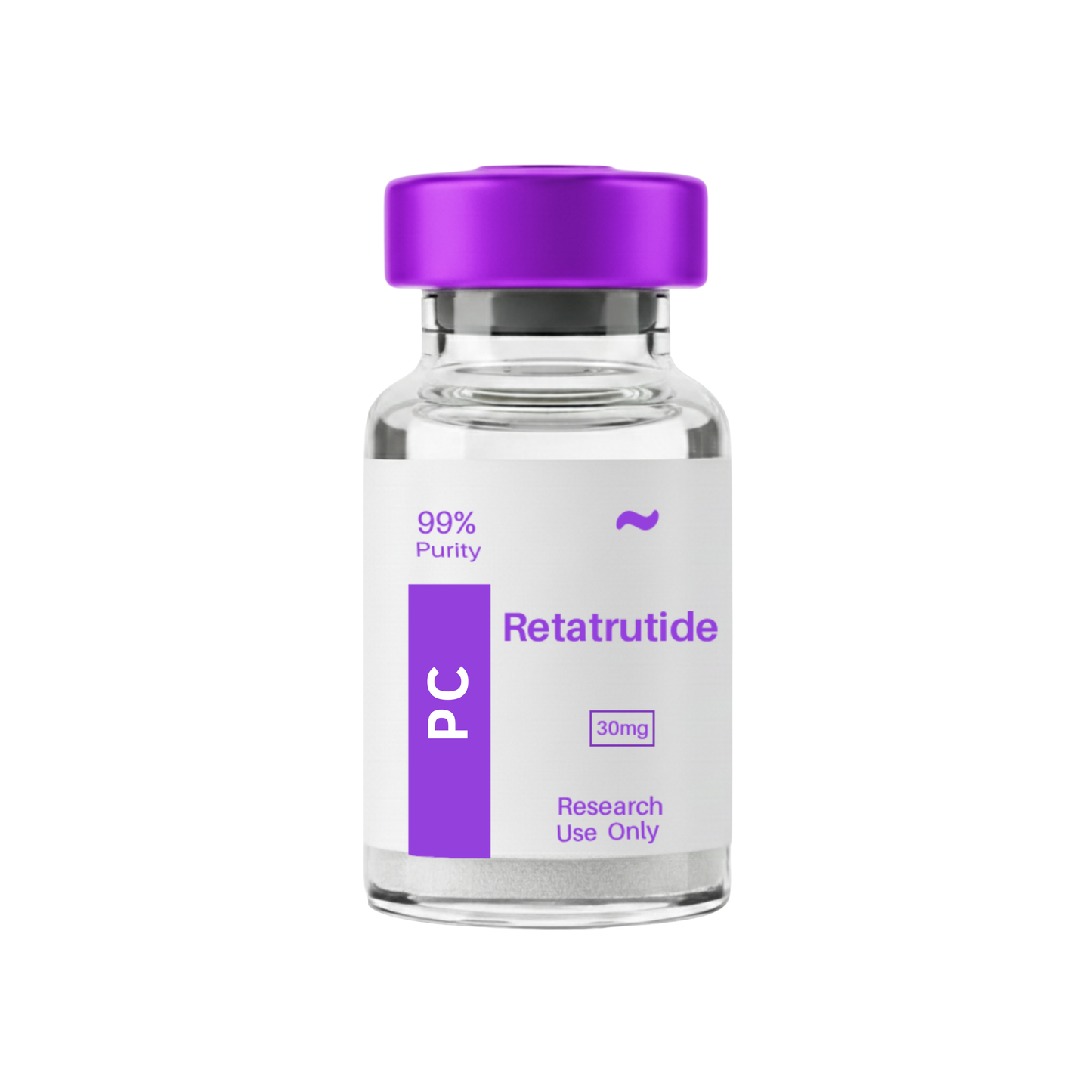
Retatrutide Triple Agonist
This batch of Retatrutide Triple Agonist Peptide has been third party lab tested and verified for quality.
Size: 20mg
Contents: Retatrutide
Form: Powder
Purity: 99.1%
Couldn't load pickup availability
Free Reconstitution Solution automatically added to your cart with each order.
This product is Made, Tested & Shipped From Canada.
Ships Today
Order by 1:00 PM EST
Free Shipping
For 2 or more vials
Verified+

Retatrutide Peptide
Retatrutide is a cutting-edge synthetic polypeptide designated as a triple incretin receptor agonist. It is uniquely engineered to activate the receptors for three major hormones regulating metabolism: GLP-1, GIP, and glucagon. This multi-targeted mechanism is the subject of extensive research for its ability to regulate overall metabolism, offering potential therapeutic applications in the areas of obesity, type 2 diabetes, and non-alcoholic fatty liver disease (NAFLD). By activating three distinct pathways, retatrutide is hypothesized to simultaneously enhance satiety, normalize glucose levels, and increase energy utilization, suggesting more profound metabolic benefits than conventional single- or dual-agonist approaches.
Retatrutide Peptide Overview
The comprehensive metabolic effect of retatrutide is driven by its ability to engage three specific hormone receptors:
- GLP-1 Receptor Activity: Stimulates insulin secretion, slows the rate at which the stomach empties, and promotes feelings of fullness. The net result is lower blood sugar and reduced caloric intake.
- GIP Receptor Activity: Supports insulin release and modulates the metabolism of fats. This activity synergizes with GLP-1 to achieve better regulation of blood sugar.
- Glucagon Receptor Activity: Elevates the body's energy expenditure and encourages the burning of fatty acids. This action contributes to a reduction in overall body fat and improves fat distribution in the liver.
This simultaneous activation of GLP-1, GIP, and glucagon receptors positions retatrutide as a potent and holistic regulator of metabolic processes. Studies indicate that this triple synergy provides superior outcomes in both weight management and glucose homeostasis compared to treatments targeting fewer hormones. Preclinical research demonstrates that retatrutide’s effects on slowing gastric emptying and decreasing food consumption result in more substantial fat loss than GLP-1 monotherapy. Furthermore, the activation of the glucagon receptor is thought to raise the metabolic rate and enhance fat oxidation, particularly in the liver, leading to improved insulin function and reduced fat accumulation in the hepatic tissue. In essence, retatrutide's mechanism is designed to optimize energy balance, glucose control, and fat metabolism concurrently, yielding broad therapeutic advantages.
Retatrutide Peptide Structure
Retatrutide is a synthetic, long-acting 39-amino acid peptide. Its extended duration of action is achieved through the incorporation of a C20 fatty di-acid chemical modification at the Lysine 20 residue. This lipidation strategy allows the peptide to bind to albumin in the bloodstream, dramatically increasing its half-life and supporting a once-weekly dosing regimen in research. The structure is carefully optimized to ensure it acts as a balanced and high-affinity agonist at the GLP-1, GIP, and glucagon receptors.
Property
Detail
Chemical Formula
C221H340N46O66
Molecular Weight
4966.5 g/mol
Amino Acid Sequence
H-Tyr-Ala-Glu-Gly-Thr-Phe-Thr-Ser-Asp-Val-Ser-Ser-Tyr-Leu-Glu-Gly-Gln-Ala-Ala-Lys(C20 di-acid)-Glu-Phe-Ile-Ala-Trp-Leu-Val-Arg-Gly-Arg-Gly-Ser-Ser-Gly-Ala-Asp-Pro-Ser-Lys-Lys-Gln-Pro-Pro-Ala-Ser
Retatrutide Peptide Research
Retatrutide and Metabolic Regulation
The activation of three distinct receptors by retatrutide is responsible for its wide-ranging metabolic effects. In early studies, the compound demonstrated an ability to slow gastric emptying and reduce food intake, leading to greater weight loss compared to compounds that target only one hormonal pathway. These superior results are linked to a dual mechanism: strong satiety signaling (from GLP-1 and GIP activation) combined with elevated energy expenditure (from glucagon receptor activation). The glucagon component is specifically implicated in boosting the basal metabolic rate and enhancing lipid oxidation.
This multi-pathway activation contributes to significant improvements in multiple metabolic health indicators. Initial human trials have substantiated these effects, showing dose-dependent decreases in both body weight and blood glucose. Researchers have also observed substantial improvements in insulin sensitivity and other beneficial metabolic adaptations, suggesting a powerful effect on restoring metabolic balance. By modulating several critical hormonal systems simultaneously, retatrutide represents a comprehensive investigational approach to addressing the core features of metabolic disease, including high glucose, excess adiposity, and disordered energy regulation.
Retatrutide and Weight Management
Clinical data indicates that retatrutide promotes powerful and substantial weight loss in research subjects with obesity. During a 48-week Phase 2 clinical trial, participants treated with the compound experienced notable, dose-dependent reductions in body weight. Subjects receiving the highest weekly dose (12 mg) achieved an average weight reduction of approximately 23–24% of their initial body weight after 11 months, far exceeding the minimal change observed in the placebo group. This magnitude of weight reduction sets a new benchmark, surpassing outcomes typically seen with previous single- or dual-agonist peptide treatments.
Even at lower to moderate doses (4 mg or 8 mg), retatrutide produced clinically significant weight reductions, with the majority of individuals losing at least 5% of their baseline weight. By week 48, 83% of participants on the 12 mg dose had achieved a minimum of 15% weight loss. These findings underscore retatrutide’s potent efficacy as an anti-obesity agent. The treatment was generally well tolerated, with a safety profile consistent with other incretin-based therapies, primarily involving mild, dose-related gastrointestinal side effects.
The profound decreases in body mass documented in these trials validate retatrutide’s potential as a highly effective new pharmacological agent for obesity management, elevating the standard for weight-loss research.
Retatrutide and Glycemic Control
Beyond its remarkable effects on body weight, retatrutide has demonstrated clear benefits in managing blood glucose for individuals with type 2 diabetes. A Phase 2 clinical study reported that retatrutide treatment led to significant improvements in glycemic control over a 36-week period. Depending on the dose, average HbA1c levels were reduced by roughly 1.3% to 2.0%, compared to negligible change in the placebo group. At the higher weekly doses (8 mg and 12 mg), retatrutide delivered greater HbA1c reductions than a common GLP-1 agonist (dulaglutide), indicating superior glucose-lowering potential.
In addition to better blood glucose management, the diabetic cohort also achieved substantial weight loss, with the highest dose group experiencing nearly a 17% body weight reduction within 8 months, significantly better than the placebo response. Importantly, retatrutide operates via a mechanism that promotes glucose-dependent insulin secretion, meaning it does not increase the risk of low blood sugar; no severe hypoglycemic episodes were reported.
Retatrutide’s broad metabolic impact may also provide other therapeutic advantages for people with diabetes. Preclinical evidence suggests potential benefits, including enhanced insulin sensitivity and reduced metabolic stress on key organs, which could play a role in preventing or slowing diabetes-related complications. In summary, emerging data strongly supports retatrutide as a promising investigational therapy capable of concurrently optimizing blood sugar, body weight, and cardiovascular metabolic health in individuals with type 2 diabetes.
Retatrutide and Liver Health (NAFLD/NASH)
A particularly exciting research avenue for retatrutide is its potential to improve liver health, especially in individuals affected by non-alcoholic fatty liver disease (NAFLD) and non-alcoholic steatohepatitis (NASH). In a sub-study of obese participants with NAFLD, retatrutide resulted in profound reductions in liver fat content. After 24 weeks of therapy, MRI measurements indicated an over 80% decrease in liver fat in the higher dose groups, compared to minimal change in the placebo group. By 48 weeks, approximately 9 out of 10 patients on the two highest doses (8–12 mg) achieved liver fat levels within the healthy range, representing a mean reduction of 82–86% and normalization of liver fat fraction (<5%) in the majority of treated subjects.
These exceptional reductions in hepatic steatosis suggest that retatrutide may effectively reverse fatty liver disease in a large proportion of patients. This effect is hypothesized to be mediated primarily by direct glucagon receptor activation within the liver, where these receptors are abundant. Their stimulation promotes the breakdown and oxidation of fatty acids, directly lowering fat accumulation in the liver. Additionally, the activation of glucagon pathways by retatrutide is thought to decrease oxidative stress in liver mitochondria and may have anti-fibrotic effects, potentially halting or reversing the progression of NASH.
Unlike GLP-1 or GIP agonists that provide liver benefits mainly through weight loss, retatrutide’s direct glucagon-mediated action offers a mechanism that may more effectively target fibrosis and inflammation. As there are currently no FDA-approved medications for NASH, retatrutide’s early evidence of improved liver function and histology represents a highly promising field of investigation. Further research is ongoing to evaluate its impact on liver enzymes, fibrosis markers, and overall hepatic well-being in individuals with metabolic-associated fatty liver disease.
Collectively, these findings confirm retatrutide as a valuable investigational compound for the management of NAFLD and NASH, reflecting its expansive systemic metabolic benefits that extend far beyond weight loss and glucose control.
Article Author
This literature review was compiled, edited, and organized by Dr. Ania M. Jastreboff, M.D., Ph.D., a leading figure in endocrinology and obesity medicine globally. Dr. Jastreboff is widely respected for her significant research contributions to metabolic therapeutics and incretin-based compounds. As an Associate Professor of Medicine and Pediatrics at Yale University School of Medicine, she has directed key clinical trials for multi-agonist peptide therapies, including the investigational agent retatrutide, which targets the GLP-1, GIP, and glucagon receptors. Her work has been crucial in advancing the scientific understanding of metabolic hormone interplay and its clinical applications in treating obesity, type 2 diabetes, and related metabolic conditions.
Scientific Journal Author
Dr. Ania M. Jastreboff has an extensive history of research focused on the pharmacological and physiological control of metabolism, with a specialized interest in incretin-based therapies and their impact on energy homeostasis and glucose regulation. She has collaborated with prominent researchers, including Drs. Louis J. Aronne, W. Timothy Garvey, Julio Rosenstock, Juan Pablo Frías, and Arun J. Sanyal, whose combined research efforts have elucidated the synergistic roles of GLP-1, GIP, and glucagon receptor activation in driving weight reduction, improving insulin sensitivity, and enhancing liver function.
Through her published findings in elite scientific publications such as The New England Journal of Medicine, The Lancet, and Nature Medicine, Dr. Jastreboff and her team have established retatrutide (LY3437943) as a crucial investigational candidate for next-generation therapy in metabolic and obesity research.
This acknowledgment serves solely to recognize the profound scientific contributions of Dr. Jastreboff and her colleagues. It does not imply any endorsement, affiliation, or commercial relationship. Montreal Peptides Canada holds no sponsorship or professional ties with Dr. Jastreboff or any of the researchers cited.
Reference Citations
- Jastreboff AM, Kaplan LM, Frías JP, et al. Triple-hormone-receptor agonist retatrutide for obesity - a phase 2 trial. New England Journal of Medicine. 2023;389:514-526. https://www.nejm.org/doi/full/10.1056/NEJMoa2301972
- Rosenstock J, Wysham C, Frías JP, et al. Retatrutide, a GIP, GLP-1 and glucagon receptor agonist, for people with type 2 diabetes: a randomised, double-blind, placebo-controlled, phase 2 trial. The Lancet. 2023;402:529-544. https://www.thelancet.com/journals/lancet/ article/PIIS0140-6736(23)01053-X/fulltext
- Sanyal AJ, Kaplan LM, Frías JP, et al. Triple hormone receptor agonist retatrutide for metabolic dysfunction-associated steatotic liver disease: a randomized phase 2a trial. Nature Medicine. 2024;30:2037-2048. https://www.nature.com/articles/s41591-024-03018-2
- Coskun T, Urva S, Roell WC, et al. LY3437943, a novel triple glucagon, GIP, and GLP-1 receptor agonist: from discovery to clinical proof of concept. Cell Metabolism. 2022;34(9):1234-1247.e9. https://www.cell.com/cell-metabolism/fulltext/S1550-4131(22)00312-6
- Katsi V, Koutsopoulos G, Fragoulis C, Dimitriadis K, Tsioufis K. Retatrutide-A game changer in obesity pharmacotherapy. Biomolecules. 2025;15(6):796. https://www.mdpi.com/2218-273X/15/6/796
- ClinicalTrials.gov. A Study of Retatrutide (LY3437943) in Participants Who Have Obesity or Overweight (TRIUMPH-1/Program). NCT05929066. https://clinicaltrials.gov/study/NCT05929066
- ClinicalTrials.gov. A Study of Retatrutide (LY3437943) in Participants With Type 2 Diabetes Mellitus Who Have Obesity or Overweight (TRIUMPH-2). NCT05929079. https://clinicaltrials.gov/study/NCT05929079
- ClinicalTrials.gov. A Study of Retatrutide (LY3437943) in Participants With Obesity: Maintenance of Weight Loss. NCT06859268. https:// clinicaltrials.gov/study/NCT06859268
- Nature Index entry for Sanyal et al. 2024 (study details & DOI). https://www.nature.com/nature-index/article/10.1038/s41591-024-03018-2
- Springer review: Retatrutide-an investigational triple agonist for obesity and diabetes (overview of safety/efficacy). European Journal of Clinical Pharmacology. 2024. https://link.springer.com/content/pdf/10.1007/s00228-024-03646-0.pdf
ALL ARTICLES AND PRODUCT INFORMATION PROVIDED ON THIS WEBSITE ARE FOR INFORMATIONAL AND EDUCATIONAL PURPOSES ONLY.
The products offered on this website are furnished for in-vitro studies only. In-vitro studies (Latin: in glass) are performed outside of the body. These products are not medicines or drugs and have not been approved by the FDA to prevent, treat or cure any medical condition, ailment or disease. Bodily introduction of any kind into humans or animals is strictly forbidden by law.
STORAGE
Storage Instructions
All products are prepared via lyophilization (freeze-drying), a process that ensures stability during shipping for approximately 3–4 months.
After the peptide powder is reconstituted using bacteriostatic water, it must be stored in a refrigerator to maintain its effectiveness. Once mixed, the solution remains stable for a period of up to 30 days.
Lyophilization, or cryodesiccation, is a specialized dehydration technique involving freezing the peptide and exposing it to low pressure. This enables the water to transition directly from solid to gas (sublimation), resulting in a highly stable, white crystalline powder known as a lyophilized peptide. This powder can be safely stored at room temperature until the point of reconstitution with bacteriostatic water.
For long-term storage, lasting several months to years, it is best practice to keep the peptides in a freezer at -80 deg C (-112 deg F). This deep-freeze temperature is critical for maintaining the structural integrity of the peptide and ensuring maximum long-term stability.
Upon receipt, peptides should be stored cool and protected from light. For short-term use, spanning days, weeks, or a few months, refrigeration below 4 deg C (39 deg F) is sufficient. Lyophilized powders are generally stable at ambient temperature for several weeks, making this acceptable for very short storage periods before use.
Best Practices For Storing Peptides
Implementing proper storage protocols for peptides is crucial for preserving the accuracy and reliability of laboratory results. Correct storage minimizes contamination, oxidation, and degradation, ensuring the peptides remain stable and fully active over extended periods. While peptides vary in their susceptibility to degradation, following best practices can significantly extend their useful lifespan and maintain their quality.
Upon receipt, store peptides in a cool, dark environment. Short-term storage (up to a few months) requires refrigeration below 4 deg C (39 deg F). Lyophilized peptides generally maintain stability at room temperature for several weeks, which is suitable for very short-term holding.
For prolonged storage, lasting many months or years, peptides must be frozen at -80 deg C (-112 deg F). This deep-freezing condition provides the best protection against degradation and structural breakdown.
It is essential to prevent repeated freeze-thaw cycles, as these fluctuations dramatically speed up peptide degradation. Additionally, avoid using frost-free freezers because their automatic defrost cycles involve temperature variations that can compromise peptide stability.
Preventing Oxidation and Moisture Contamination
Protecting peptides from air and moisture exposure is vital, as both can quickly compromise stability. Moisture contamination is a significant risk when cold peptides are removed from the freezer. To prevent condensation from forming on the peptide or inside the vial, always ensure the container is allowed to reach room temperature before opening.
Minimizing exposure to air is equally important. The peptide container should be kept closed as much as possible, and it should be promptly resealed after removing the necessary amount. Storing the remaining peptide under an inert, dry gas atmosphere (such as nitrogen or argon) can further protect against oxidation. Peptides containing the residues cysteine (C), methionine (M), or tryptophan (W) are particularly sensitive to air oxidation and require extra care.
To maximize long-term stability, avoid frequent thawing and refreezing. A highly recommended strategy is to divide the total peptide quantity into smaller aliquots, each reserved for a single experiment. This technique prevents repetitive exposure to air and temperature changes, preserving the integrity of the remaining peptide.
Storing Peptides In Solution
Peptides stored in solution have a substantially shorter shelf life than lyophilized peptides and are more vulnerable to bacterial degradation. Peptides containing residues like cysteine (Cys), methionine (Met), tryptophan (Trp), aspartic acid (Asp), glutamine (Gln), or N-terminal glutamic acid (Glu) tend to degrade faster when in a liquid state.
If storage in solution is necessary, it is best to use sterile buffers with a pH ranging from 5 to 6. The solution should be aliquoted immediately to reduce the number of freeze-thaw cycles. When refrigerated at 4 deg C (39 deg F), most peptide solutions remain stable for up to 30 days. However, peptides known to have low stability should be kept frozen until immediately prior to use to best maintain their structural integrity.
Peptide Storage Containers
Storage containers for peptides must be clean, clear, durable, and chemically resistant. They should also be correctly sized to minimize the amount of excess air space above the stored peptide. Both glass and plastic vials are acceptable. Plastic options are typically made from polystyrene (clear, but less chemically resistant) or polypropylene (more chemically resistant, though usually translucent).
High-quality glass vials offer the best overall combination of chemical inertness, clarity, and stability for peptide storage. However, peptides are often shipped in plastic containers to mitigate the risk of breakage during transit. Peptides can be safely transferred between glass and plastic vials to meet specific experimental or storage demands.
Peptide Storage Guidelines: General Tips
To maintain optimal peptide stability and prevent degradation, follow these essential guidelines:
- Store peptides in a cold, dry, and dark environment.
- Avoid repeated freeze-thaw cycles to protect peptide integrity.
- Minimize air exposure to reduce the chance of oxidation.
- Protect peptides from light to prevent structural changes.
- Store lyophilized whenever possible; avoid long-term storage in solution.
- Aliquoting is recommended to prevent unnecessary handling and exposure.
Certificate of Analysis (COA): Lab report for this product purity, identity, and chromatograms.
-

PURE INGREDIENTS
Products crafted in regulated, compliant facilities.
-

EFFICIENT LOGISTICS
Trustworthy 3-5 day shipping service.
-

GROWING KNOWLEDGE BASE
Peptide experts available to assist 24/7.
You may also like
-
SAVE 25%Reconstitution Solution
Regular price $15.00Regular price $15.00 Sale priceUnit price / per$20.0025% -
SAVE 23%Retatrutide Triple Agonist
Regular price From $90.00Regular price From $90.00 Sale priceUnit price / per$118.0023% -
SAVE 23%Glutathione
Regular price From $75.00Regular price From $75.00 Sale priceUnit price / per$98.0023%
Every vial we sell comes from a lab that follows current Good Manufacturing Practices (cGMP). That means each step of production is documented and controlled. Before a batch is released, it’s tested by independent third-party labs for purity, identity, and sterility. Certificates of analysis are available so you can see the exact test results.
Yes. The labs we work with use ISO-certified clean rooms where air quality, equipment, and handling procedures are tightly regulated. Staff are trained to pharmaceutical-grade standards. This ensures the peptides are produced in an environment that minimizes contamination risks.
Peptides in lyophilized (freeze-dried) form are stable at room temperature for transport. Once you receive them, refrigeration is recommended to maintain long-term integrity. We package every order securely to prevent damage and ship promptly, so your vials arrive in optimal condition.
We operate under strict in-house protocols that follow current Good Manufacturing Practices (cGMP). That means our team oversees the entire process from sourcing raw amino acids to the final lyophilized vial. Nothing is outsourced or repackaged. This gives us full control over purity, consistency, and sterility, and it’s why we can stand behind every single vial we ship.
Store them in the refrigerator, away from direct light and heat. If you need to keep them longer, some peptides can be stored frozen. Each vial comes with clear handling instructions so you know the proper conditions for stability.
The strongest proof is transparency. For every peptide, we can provide certificates of analysis, manufacturing documentation, and references to the published scientific research behind it. If you ever have questions, we’ll show you the data rather than ask you to take our word for it.
The difference is transparency. Most sites give you a product name and a price. We provide full batch testing, lab documentation, and direct access to certificates of analysis so you don’t have to guess what you’re getting. When you order from us, you know exactly what’s in the vial, where it was made, and how it was verified.